
The Product We Promised at ISE Won Best Paging System at InfoComm 2026

The Product Behind the Trophy
InfoComm 2026 in Las Vegas was three days, one booth, and a long list of good conversations. It was also the show where we introduced the biggest thing our team has built in years, and where that product walked away with an award.
nnounce distributed paging picked up a Best of InfoComm 2026 Award, named the best paging system at the show. Not a bad way to introduce a product.
If you stopped by N6305 to say hello, thank you. It was good to put faces to names and hear what you are building. If you did not make it over, here is everything you missed.
A Few Big Days in Las Vegas
InfoComm puts the entire industry in one building for three days, which makes for long hours and very few dull ones. We shared the stand with Simpleway and had steady traffic from open to close.
The conversations were the reason to be there. Integrators working out how to bid their next mission-critical job. Programmers who spend their days inside Q-SYS. Airport and transit operations people who know exactly how a paging system behaves during a 6 a.m. rush. And a good number of faces we only ever catch once a year. That is what brings us back.
The Big Reveal: nnounce Distributed Paging
The announcement we came to make was nnounce distributed paging, and it is where most of our engineering effort has gone over the past year.
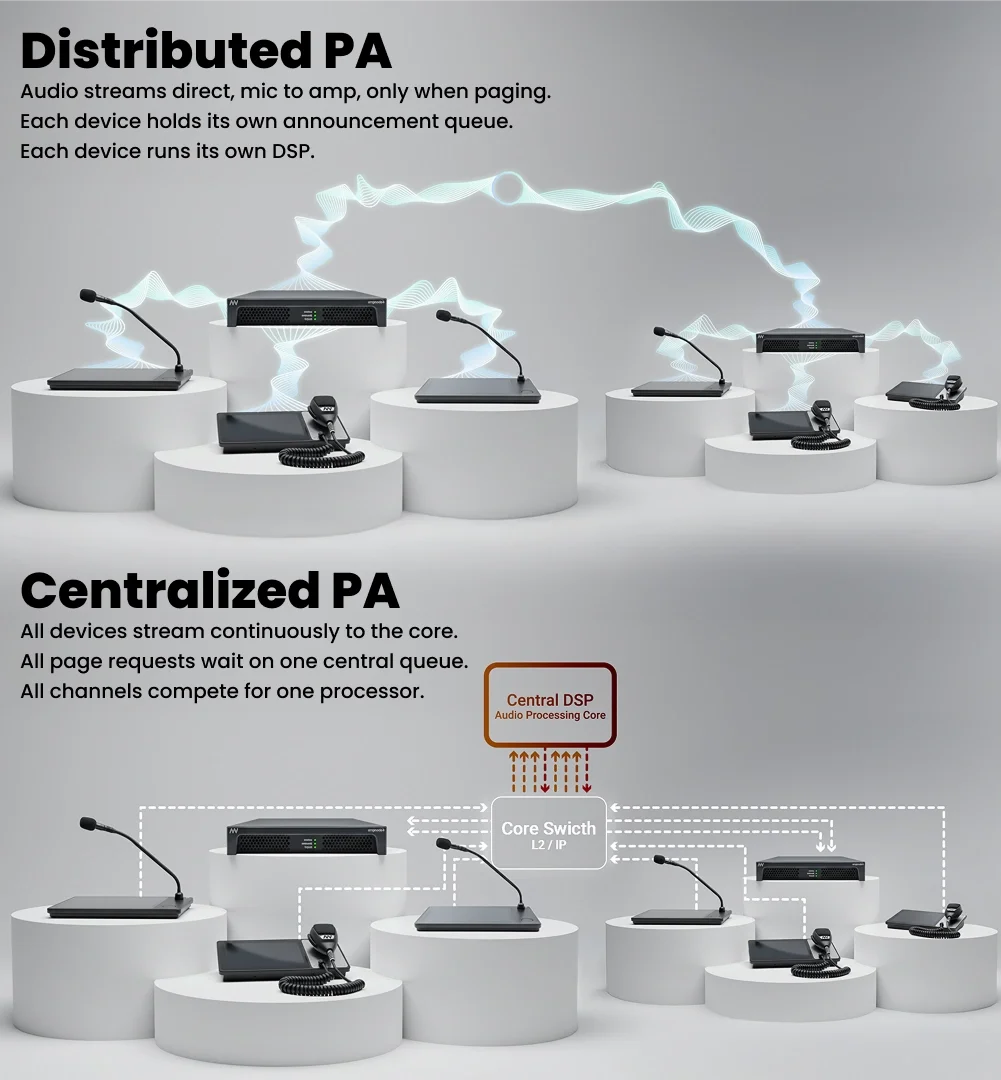
It rethinks something the industry stopped questioning a long time ago. Nearly every paging system is organized around one central unit that holds the control logic, routes the audio, and handles the processing. That unit is the intelligence of the system and it is also its most expensive point of failure. When it stops, so does every announcement in the building.
What Is Distributed Paging?
The principle is simple. There is no controller, because every device is one. Each unit runs its own logic, keeps its own queue, and decides for itself what to play and when. Devices coordinate with each other directly across the IP network the building already has.
Three things follow from that:
Failures stay local. A device that reboots or falls off the network takes only itself out of service. Everything else carries on paging.
Capacity grows with the system. Adding coverage means adding devices. There is no central appliance to outgrow and replace halfway through the building's life.
Audio takes the short path. Announcements travel point to point instead of through a single hub, so nothing queues behind a shared processor.
The word "distributed" makes people brace for a management headache, and that was the first question we got at the booth most days. It does not work out that way. Every device in the network is set up, updated, and monitored as one system from a single interface, with one place for user permissions and one record of what was played. Operators get a system that behaves as if it were centralized. Only the execution is spread out.
Best Paging System at InfoComm 2026
We were confident the concept would land. A trophy was not part of the plan. rAVe [PUBS] gave nnounce distributed paging a Best of InfoComm 2026 Award, naming it the best paging system at the show. Recognition from people who spend the whole year watching this market carries a particular kind of weight.
rAVe also recorded an interview with one of our team that goes further into the architecture and the reasoning behind it. If you want it explained by someone who built it, it is a few minutes well spent.
The Devices Behind Distributed Paging
The architecture is only half of it. Distributed paging runs on nnounce hardware, and we brought a broad slice of the lineup to Las Vegas, including paging stations, amplifiers, and the audio integration devices that hold a system together.
Visitors kept picking the units up off the table, which is always a good sign. The industrial design is deliberately understated and the build is made for sites where a failed device is a real problem, not an inconvenience.
For anyone designing in Q-SYS, most of the lineup is Q-SYS Verified and listed in the Q-SYS library. A Q-SYS Verified plugin brings the devices into the ecosystem you already work in, so specifying nnounce is a supported path rather than an exercise in workarounds.
It also fits what is already installed. Keep your DSP, your amplifiers, your speakers, and your network. nnounce sits above them as the paging and operator layer, so moving to distributed paging does not turn into a full infrastructure replacement.
Let's Talk
If you are putting together a mission-critical tender, reconsidering the paging layer at an airport or transit hub, or simply curious whether this architecture suits your site, we are interested in what you are working on.
For anyone scoping systems for 2027, this is when those choices get made.
Reach out and let's work through it, or book a 1:1 session for a walkthrough with one of our engineers.